The Complete AEO Guide: How to Get Cited by ChatGPT & Gemini (2026)

Arpit Dhadhuk
Lead SEO Specialist
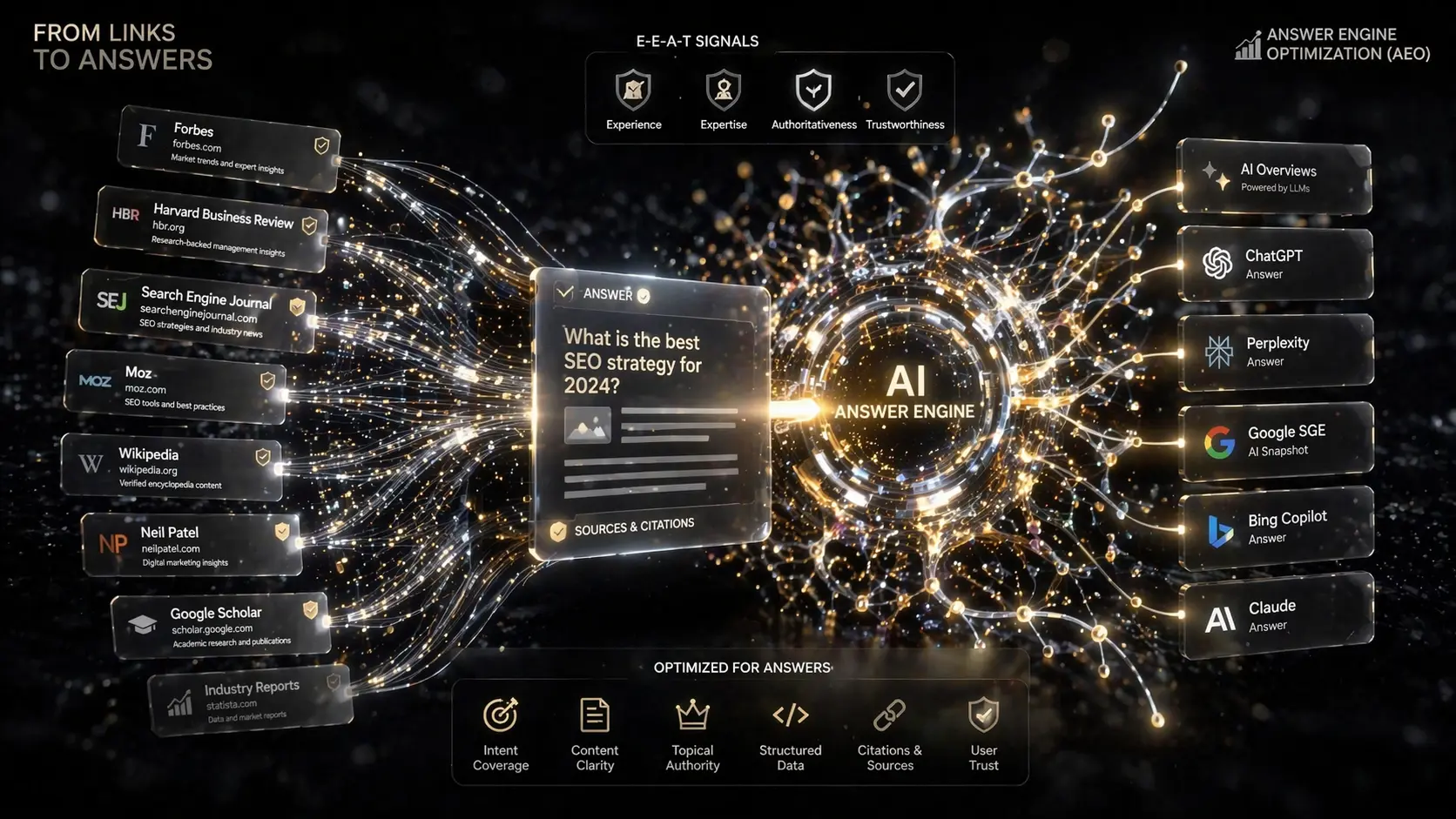
Sixty percent of Google searches now end without a single click. AI Overviews answer the question before anyone visits your website. ChatGPT, Gemini, and Perplexity are where a growing number of B2B buyers start their research — and none of them are clicking your blue links.
If your brand is not showing up in those AI-generated answers, you are invisible to a significant chunk of your market. That is the problem Answer Engine Optimization (AEO) solves.
This guide gives you a practical, step-by-step framework for getting your content cited by the AI platforms your buyers actually use — without abandoning the SEO strategy that still drives your organic traffic.
What Is Answer Engine Optimization (AEO)?
Answer Engine Optimization is the practice of structuring your content so that AI systems — ChatGPT, Google Gemini, Perplexity, Claude, and Bing Copilot — choose your brand as a source when generating answers.
It is related to SEO and GEO (Generative Engine Optimization), but they are not the same thing:
In 2026, a complete search strategy requires all three.
Why AEO Matters for B2B Brands in 2026
B2B buyers are increasingly using AI tools as their first research step. Before they visit your website, read a review, or talk to a sales rep, they are asking ChatGPT questions like *"what is the best marketing automation tool for a SaaS startup"* or *"how do I improve my B2B lead generation."*
If AI platforms do not know your brand exists — or do not trust your content enough to cite it — you are missing the earliest and most influential stage of the buyer journey.
The brands that invest in AEO now have a compounding advantage. As AI search grows, their visibility grows with it. Brands that ignore it are building an SEO strategy for a search landscape that is already changing underneath them.
How AI Engines Decide Which Sources to Cite
AI answer engines do not rank pages the way Google does. They synthesize information from multiple sources and generate a response. But the sources they pull from are not random. Several signals influence whether your content gets cited:
The 6-Step AEO Framework
Here is the exact process to make your content citation-ready across major AI platforms.
Step 1: Write for extraction, not just reading
Every section of your post should be able to stand alone as an answer. Use a clear H2 that poses a question or states a topic. Open each section with a direct 1–2 sentence answer. Then expand. AI systems pull the top of each section — if your answer is buried in paragraph three, it will not get cited.
Step 2: Add a FAQ section to every post
A FAQ section targeting real "People Also Ask" questions is one of the highest-leverage AEO tactics available. Find 5–6 questions by searching your primary keyword in Google and noting the PAA box. Write direct, 2–4 sentence answers for each. Then add `FAQPage` schema so AI engines can extract them cleanly.
Step 3: Implement Article and FAQPage schema
Schema markup is the technical signal that tells AI and search engines exactly what your content is and who created it. At minimum, every blog post needs `Article` schema with publish dates, author name, headline, and description. FAQ sections need `FAQPage` schema wrapping each question-answer pair.
Step 4: Build verified author credentials
Every post on your site should have a named author — a real person with a bio, a headshot, and a LinkedIn URL. Google and AI engines use author signals as a proxy for expertise. A post attributed to "ThynkUnicorn Team" carries far less weight than one attributed to a named individual with demonstrable credentials.
Step 5: Earn brand mentions across trusted sources
AI engines build their model of which brands matter in a space based on how often those brands are mentioned in high-authority sources — industry publications, podcast transcripts, forum discussions, third-party review sites. Guest posting, Digital PR, and active participation in industry communities build this signal over time.
Step 6: Keep content fresh and dated
Set a quarterly review calendar for your top posts. Update statistics, add new sections where the topic has evolved, and update the `dateModified` in your schema. Stale content gets deprioritized by both Google and AI systems in fast-moving categories.
AEO Readiness Checklist
Run this against every post you publish from now on:
Frequently Asked Questions About AEO
What is AEO in marketing?
AEO stands for Answer Engine Optimization. It is the practice of structuring content so that AI-powered tools like ChatGPT, Gemini, and Perplexity cite your brand when generating answers to user questions. Unlike traditional SEO, which targets ranked links, AEO targets direct citations in AI-generated responses.
How do I get cited by ChatGPT?
The most effective approach is to create structured, extraction-friendly content with clear headers, direct answers, FAQ sections with `FAQPage` schema, and verified author credentials. ChatGPT's web search pulls from high-authority sources, so earning backlinks and brand mentions in trusted publications also increases your citation likelihood.
Is AEO replacing SEO?
No — AEO complements SEO rather than replacing it. Traditional search still accounts for the majority of discovery. However, the two are converging: content that ranks well in Google tends to be well-structured and authoritative, which are the same signals AI engines favor.
How long does AEO take to work?
Unlike paid ads, AEO is a compounding strategy. Implementing the technical changes (schema, author bios, FAQ sections) can be done immediately. Building the brand authority signals that AI engines trust — through consistent content, backlinks, and Digital PR — typically takes 3–6 months to show measurable improvement in AI citation frequency.
What tools can I use to track AEO performance?
In 2026, dedicated AEO tracking tools include AIclicks, Gauge, and Rank Prompt. These track how often your brand is cited across ChatGPT, Gemini, Perplexity, and Bing Copilot. For a free starting point, manually search your target keywords in each AI platform weekly and note whether your brand appears in the generated answers.
Want to know if your site is AEO-ready?
ThynkUnicorn offers a free SEO & AEO audit for B2B brands and agencies. We review your content structure, schema setup, author signals, and brand mention profile — then give you a prioritized action plan.